How to Optimise a Service Business Website for AI Search
A practical 2026 guide to making service business websites easier for ChatGPT, Gemini, Perplexity and Google AI to identify, verify and recommend.
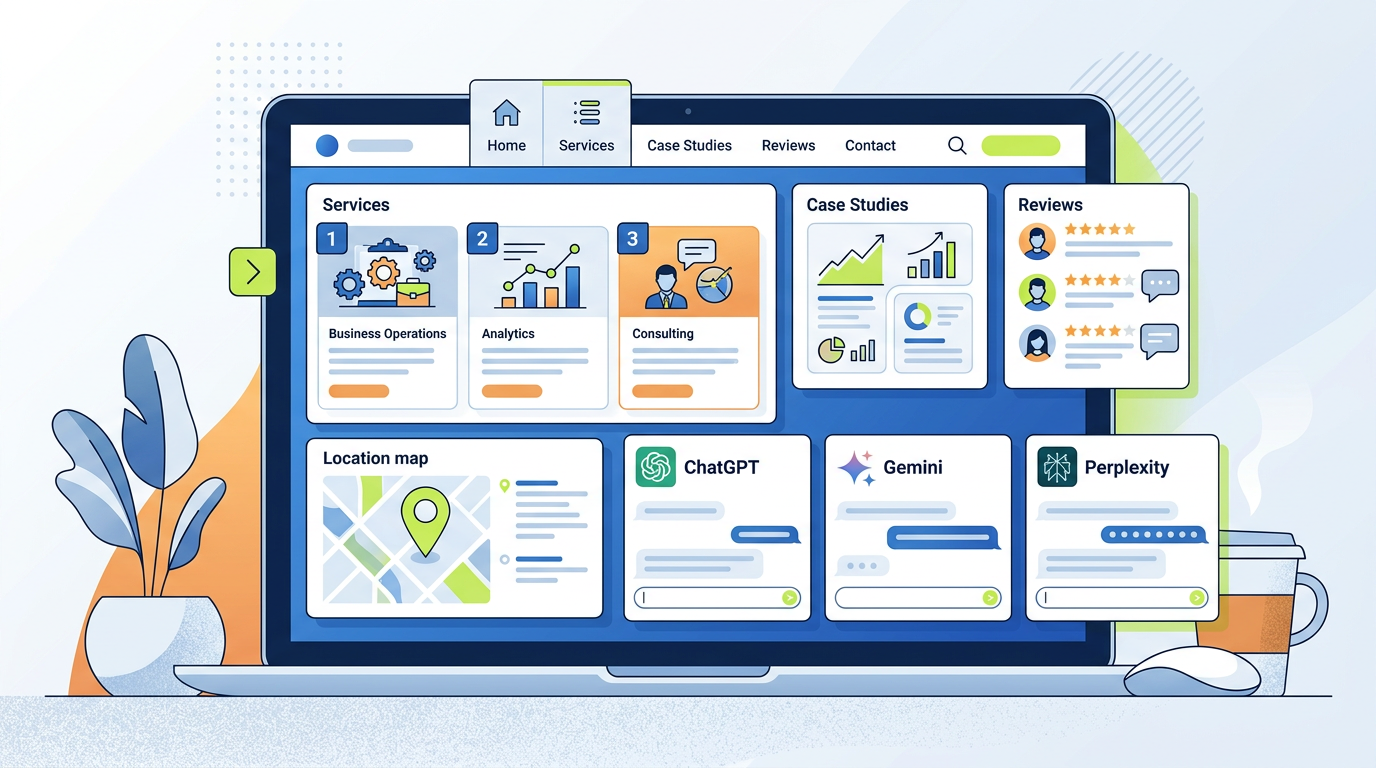
AI search recommends service businesses it can identify, verify and compare with confidence. In 2026, that means more than adding schema or publishing AI-written blogs: your site needs clear services, named expertise, proof of work, consistent local data, transparent pricing signals and third-party citations that ChatGPT, Gemini, Perplexity and Google can cross-check.
What makes an AI assistant recommend one service business over another?
When someone asks, “Who is a good web designer for an NGO in Delhi?” or “What SEO consultant can help a UK business target India?”, an AI assistant has to assemble an answer from available evidence. It is not simply rewarding the page with the most keywords.
It looks for a business that appears to be:
- A real, identifiable entity
- Relevant to the specific service and location
- Experienced in the requested type of work
- Supported by original evidence
- Mentioned consistently across the web
- Easy to compare with alternatives
- Safe to recommend without overstating claims
For a service business, recommendation eligibility usually comes down to four layers:
| Layer | What AI systems need to understand | Practical proof |
|---|---|---|
| Entity | Who you are, where you operate and what you do | About page, author page, business profiles, consistent name/address/contact details |
| Relevance | Whether you solve the exact problem asked | Focused service pages, industry pages, useful FAQs, comparison content |
| Evidence | Whether you have done this work before | Case studies, project screenshots, deliverables, outcomes, client testimonials |
| Corroboration | Whether external sources support your claims | Google Business Profile, reviews, directories, LinkedIn, client links, reputable mentions |
AI search does not need your business to be famous; it needs your claims to be easy to verify.
On my own site, I do not try to position myself as a generic “digital agency”. I am specific: I design conversion-focused websites and support SEO/AEO work for businesses in India, the US, UK, Australia and the Gulf. That clarity makes it easier for search systems and prospective clients to connect the service, the audience and the operator.
This is different from the broader strategy in my guide on getting cited by ChatGPT and AI search tools. Here, the focus is the service-business website itself: the pages, evidence and signals that make a recommendation defensible.
Build a clear entity footprint before publishing more content
Most weak service websites have an entity problem before they have a content problem. Their homepage says “innovative solutions”, the About page says almost nothing about the founder, and the contact page hides location, working hours and service scope.
That makes it difficult for an AI system to answer basic questions: Who runs this business? Is it local or remote? What does it actually sell? Is it still active?
Make your business identity consistent everywhere
Start with one canonical version of your business details. Use it on your website, Google Business Profile, LinkedIn, review platforms, invoices, social profiles and relevant directories.
Your core entity record should include:
- Business name
- Founder or lead practitioner name
- Primary location and service areas
- Phone number and business email
- Website URL
- Primary services
- Industries served
- Operating model: local, remote, international or hybrid
- Years of experience, only if accurate
- Social/profile links you actively maintain
For example, “Delhi-based web designer serving India and overseas clients remotely” is clearer than listing five virtual offices you do not operate from.
I would not recommend inventing city locations or creating fake local profiles to appear national. It may create short-term map visibility, but it weakens trust and can lead to profile suspensions.
Build the pages that establish “who”
A service business should have these minimum entity pages:
- Homepage with a one-sentence service and market position
- About page naming the person or team doing the work
- Contact page with direct contact options and location context
- Service pages with clear scope
- Portfolio or case-study pages
- Privacy, terms and refund/process policies where relevant
For a solo consultant, hiding behind “we” is not always helpful. Naming the practitioner can make the expertise easier to assess. I use a first-person operator position because clients are hiring a person with a process, not an anonymous content machine.
On a recent NGO-oriented build, the strongest credibility assets were not decorative design elements. They were clear project information, real organisational context and visible contact paths. You can see that approach in the Sarv Dharam Sewa Sangh project, where the work is tied to a real organisation and a defined mission.
A business becomes easier to recommend when its identity is consistent enough to be recognised across multiple sources.
Check whether your entity can be found
Search these queries manually in Google, Bing, ChatGPT, Perplexity and Gemini:
[business name][founder name] [business name][business name] reviews[business name] [primary service][business name] [city]best [service] for [industry] in [location]
You are checking for confusion, not just rankings. If results show a different business, an old address, incomplete profiles or no meaningful first-party source, fix those gaps before spending heavily on more blog content.
Turn every service page into evidence an AI system can verify
A service page should not be a 400-word sales brochure filled with “tailored”, “strategic” and “results-driven”. AI systems need concrete information they can extract, quote and compare.
The best service pages answer practical buying questions directly:
- What exactly do you do?
- Who is it for?
- What is included?
- What is not included?
- What does the process look like?
- How long does it take?
- What does it cost or what affects cost?
- What proof do you have?
- What should a buyer prepare?
- How does someone start?
Use an evidence-led service-page structure
For web design, SEO consulting, legal services, clinics, recruitment firms, accountants, agencies and local specialists, I would use this structure:
- Direct definition of the service
- Ideal client and use cases
- Specific deliverables
- Process and timeline
- Pricing range or pricing factors
- Relevant project examples
- What you do not offer
- FAQs based on real sales questions
- Clear enquiry or booking CTA
A conversion-focused website project may be priced very differently based on scope. A small five-page service site can sit around ₹60,000–₹1.5 lakh ($700–$1,800) with an experienced Indian studio, while a strategy-heavy US or UK agency engagement can easily reach $5,000–$20,000+. Those are broad market ranges, not a universal quote. Verify current local pricing by reviewing comparable providers and asking for a written scope.
The point is not to publish a fixed price if your work is custom. The point is to eliminate ambiguity.
Add “what is included” and “what is not”
This is where many service websites become far more useful to AI search.
For example, a web design service page could state:
| Included in a typical website build | Usually separate or not included |
|---|---|
| UX sitemap and page structure | Paid advertising spend |
| Responsive website design | Ongoing daily social media management |
| WordPress or Webflow implementation | Enterprise CRM custom development |
| Basic on-page SEO setup | Guaranteed rankings |
| Contact or lead form setup | Unlimited post-launch revisions |
| Analytics and Search Console setup | Professional photography or copywriting, unless scoped |
Clear exclusions build more trust than vague promises of “everything you need”.
I would not recommend claiming guaranteed Google rankings, guaranteed AI citations or guaranteed leads. No credible SEO or AEO provider controls those systems. A better promise is a defined implementation process, measurable technical work and transparent reporting.
Show first-party work, not generic stock claims
Service pages should link to relevant work. If you offer salon websites, show salon work. If you support travel businesses, show travel work. If you build NGO websites, show NGO work.
For example:
- Buddha Beauty Point supports a salon-specific portfolio claim.
- Luft Holidays supports travel-industry website experience.
- Sarv Dharm Blood demonstrates work involving a more complex public-service platform.
This is stronger than a page that says, “We work across all industries” without showing evidence.
Create comparison and decision content for high-intent AI queries
AI assistants are increasingly used before a buyer visits a website. Users ask questions such as:
- “Should I hire a freelancer or agency for a website?”
- “Is Webflow better than WordPress for a consultancy?”
- “What does SEO cost in India versus the UK?”
- “Do I need local SEO if I serve clients remotely?”
- “Which web designer is suitable for an NGO?”
- “Should I hire offshore or locally?”
These are recommendation and comparison queries. If your site has no useful answer, it gives an AI assistant little reason to cite you.
Publish content that helps someone choose
The goal is not to create dozens of “best service provider” listicles about yourself. The goal is to explain real trade-offs with evidence and clear boundaries.
Useful decision pages include:
- Freelancer vs agency vs in-house team
- WordPress vs Webflow vs Shopify for a specific business type
- Local provider vs offshore partner
- One-time SEO setup vs monthly SEO retainer
- Cheap website package vs conversion-focused website build
- DIY website builder vs professional design
- Industry-specific website requirements
I have already covered budget trade-offs in detail in What a Conversion-Focused Website Costs in the US vs India and the operational side in Working With an Offshore Web Partner Across Time Zones. A service business should build equivalent decision assets around its own work.
Use honest comparison tables
Tables are easy for readers to scan and easy for machines to interpret. They also force you to be specific.
| Option | Typical budget | Best for | Main trade-off |
|---|---|---|---|
| DIY site builder | $0–$500 / ₹0–₹40,000 | Very early-stage businesses with time to learn | Lower cash cost, higher owner time and limited strategy |
| Low-cost freelancer | $300–$1,500 / ₹25,000–₹1.25 lakh | Simple brochure sites with a clear brief | Quality and support vary widely |
| Specialist independent consultant | $1,000–$5,000 / ₹80,000–₹4 lakh | Businesses needing strategy plus delivery | Capacity can be limited |
| Small agency | $3,000–$15,000+ / ₹2.5 lakh–₹12 lakh+ | Multi-page projects with multiple stakeholders | More process and higher cost |
| Enterprise agency | $20,000+ / ₹16 lakh+ | Complex integrations, compliance or large organisations | Slowest and most expensive option |
These figures vary by market, scope, platform and content requirements. Use them as decision ranges, not fixed quotes.
Answer the objections buyers actually raise
A strong AI-search content plan includes questions a sales call repeatedly receives:
- “Can you work with a client in another time zone?”
- “Will I own the website after launch?”
- “Can you migrate my existing site?”
- “Do you provide copywriting?”
- “How quickly can the site go live?”
- “What happens after launch?”
- “Can you work with an Indian NGO on a limited budget?”
- “Do I need ongoing SEO?”
These are not minor FAQs. They are buyer-intent assets.
Strengthen local trust signals across Google, maps, reviews and directories
Local trust remains important even when a service business sells internationally. A Delhi consultant can work with clients in the US, UK, Australia and the Gulf, but the business still needs a credible home base.
For local queries, Google Business Profile, review consistency, map visibility and location-relevant evidence matter. For international work, these still help establish legitimacy.
Keep Google Business Profile accurate and active
Your Google Business Profile should match your website closely:
- Correct business name
- Correct category
- Real address or compliant service-area setup
- Phone number and website URL
- Accurate hours
- Services listed in plain language
- Recent photos of real work, team or workspace where possible
- Consistent responses to reviews
- Updates when details change
For Delhi businesses, I have covered the practical setup in Local SEO for Delhi Businesses: The Google Business Profile Playbook. The same core principle applies elsewhere: do not treat the profile as a one-time listing.
Collect reviews with service context
A review that says “Great service” is useful but weakly descriptive. A review that says, “Prateek redesigned our NGO website, clarified our donation flow and made it easier for visitors to contact us,” is much more informative.
Do not script reviews or offer incentives that violate platform policies. Instead, send a simple request after delivery:
- What problem did you need solved?
- What work was completed?
- What changed after the project?
- Would you recommend the provider, and for what type of business?
This naturally produces useful service and industry context.
Use reputable directories selectively
You do not need 100 low-quality citations. Focus on profiles where clients or partners may genuinely look:
- Google Business Profile
- LinkedIn company and personal profile
- Industry associations
- Chamber or local business groups
- Credible agency directories, where appropriate
- Relevant marketplace profiles you actively use
- Client websites that credit you
I would not recommend buying “10,000 directory submissions”. Most create inconsistent data, weak links and cleanup work.
Ten accurate, maintained citations are more valuable than hundreds of automated directory listings.
Use schema as supporting infrastructure, not the whole AEO strategy
Schema markup helps search engines understand the structure of a page. It does not manufacture trust, create expertise or force an AI assistant to recommend you.
This is the point many AEO packages get wrong. Adding Organization, LocalBusiness, Service, FAQPage, Person, WebSite and Review markup can be useful, but only when the visible page content supports it.
The schema I usually prioritise
For a typical service business site, I would assess:
OrganizationorLocalBusinessProfessionalServicewhere appropriatePersonfor the founder or named expertWebSiteWebPageServiceBreadcrumbListFAQPagefor genuine on-page FAQsArticlefor editorial contentRevieworAggregateRatingonly when eligible and displayed correctly
Use JSON-LD, validate with Google’s Rich Results Test and Schema Markup Validator, then check rendered pages. WordPress sites can use Rank Math, Yoast SEO or custom JSON-LD; Webflow may need structured embeds or a CMS-based implementation. Tool versions change frequently, so confirm current documentation before relying on plugin defaults.
Avoid schema abuse
I would not recommend:
- Marking up reviews that are not visible on the page
- Inventing aggregate ratings
- Adding FAQ schema to irrelevant questions
- Using
LocalBusinessfor a virtual location you do not operate - Marking every page as every possible service type
- Treating schema validation as proof you will receive rich results
Schema is plumbing. Your services, proof and external corroboration are the building.
For a broader platform-by-platform explanation, read AEO & GEO in 2026: How to Get Cited by ChatGPT, Gemini and Perplexity.
Build citation-worthy proof: projects, outcomes, pricing and expert authorship
The easiest content for AI systems to cite is specific, useful and attributable. “We deliver excellence” is not cite-worthy. “We built a donation-focused NGO website with these pages, this workflow and these constraints” is.
Turn portfolio entries into mini case studies
A portfolio grid with screenshots is useful for design credibility, but it is not enough for recommendation queries. Each meaningful project should answer:
- Who was the client or organisation, if public
- What problem needed solving
- What pages, features or systems were delivered
- What constraints mattered
- What changed after launch, if measurable
- Which platform and tools were used
- Who the project is suitable for
Not every client can share metrics, and that is fine. Do not invent traffic gains or conversion lifts. Explain the work and the decision-making instead.
For example, a project like NotesBhandar can demonstrate experience with a resource-heavy education platform. A project such as [VediCosmic](https://portfolio.techtipstool.com/portfolio/VediCosmic- Spiritual Tools Website) can support work in a niche ecommerce or spiritual-products context. The relevance comes from accurate description, not exaggerated outcomes.
Make authorship visible
For advisory or expert-led services, show who wrote the content and why they are qualified to write it. A short author box should include:
- Name
- Role
- Relevant experience
- Location or market context
- Link to About page or LinkedIn
- Date updated
- Editorial or review process, where relevant
This matters especially for finance, health, legal, education and high-stakes services. If the topic requires regulated expertise, involve a qualified professional. I would not recommend using generic AI copy as a substitute for a licensed adviser’s review.
Publish useful original assets
Original assets create reasons for others to cite you:
- A pricing calculator
- A website launch checklist
- A migration planning template
- An industry-specific requirements list
- A downloadable scope document
- A local guide based on actual operator experience
- A client onboarding questionnaire
- A transparent “what we do and do not do” page
A simple calculator or checklist can outperform 20 generic blog posts because it solves a real task.
Measure AI-search visibility and run a 90-day optimisation sprint
AI search measurement is imperfect. Google Search Console does not cleanly label every AI Overview interaction, and ChatGPT, Gemini and Perplexity provide different levels of referral visibility. You still need a disciplined measurement process.
Track leading and lagging signals
Use Google Search Console, GA4, Bing Webmaster Tools, server logs where available, and your CRM or form data.
Track:
- Branded searches and branded impressions
- Service-plus-location query impressions
- Clicks and conversions from organic search
- Referral traffic from AI platforms when available
- Mentions or citations in AI responses during manual testing
- Growth in quality reviews
- New external references and client backlinks
- Leads that mention ChatGPT, Gemini, Perplexity or AI research
- Conversion rate by service page
Ask every qualified lead, “How did you find us?” Add “AI assistant/ChatGPT/Gemini/Perplexity” as an option in your form. This is simple and more reliable than pretending attribution is perfect.
For a fuller measurement framework, see Zero-Click Is the New Baseline: Measuring SEO Success When AI Answers First.
A practical 90-day plan
Days 1–30: Fix entity and service fundamentals
- Audit homepage, About, contact and service pages for clear business identity
- Standardise name, contact details, location and service descriptions
- Claim or improve Google Business Profile
- Add or correct Organisation, Person, Service and Breadcrumb schema
- Create a conversion-friendly contact path
- Identify your three highest-value services and top two customer segments
- Add links from service pages to relevant portfolio projects
Days 31–60: Publish proof and decision content
- Upgrade three priority service pages using the evidence-led structure
- Publish two real case studies or expanded portfolio entries
- Create one comparison page based on a common buyer decision
- Add transparent pricing ranges or pricing factors
- Request reviews from recent clients using a compliant process
- Add author bios and update dates to key educational pages
Days 61–90: Build corroboration and measure
- Audit major directory and profile consistency
- Seek relevant client credits, partner mentions or industry listings
- Test 20 real AI-search prompts monthly and document citations
- Review Search Console query changes and page-level conversions
- Improve pages that get impressions but weak clicks or enquiries
- Remove thin, duplicated or unsupported content
A realistic early win is better clarity and stronger branded visibility within weeks. Broader citations and recommendation frequency can take several months because they depend on crawling, indexing, third-party signals, query demand and competition.
AEO/GEO is not a 30-day trick; it is the process of making your business consistently easier to verify.
The bottom line
To optimise a service business website for AI search in 2026, build a business that AI systems can confidently describe: clear entity details, specific service pages, real project evidence, honest comparisons, local trust signals and properly supported schema.
Do not spend your budget on bulk AI blogs, fake reviews or schema-only “AEO packages”. Start with the pages buyers and AI assistants need to assess you.
If you want a practical starting point, review my services, browse the portfolio, or request a free 48-hour website mockup through the contact page.
FAQ
Can a small local service business appear in ChatGPT or Google AI Overviews?
Yes. A small business can appear when it has strong relevance to the query and enough verifiable evidence online. Clear service pages, an accurate Google Business Profile, genuine reviews, local mentions and original case studies matter more than having a large team or a huge content library.
Does schema markup make a business rank in AI search?
No. Schema helps systems understand page structure and entity relationships, but it does not create authority or guarantee citations. Use it to support visible, accurate information rather than as a replacement for proof, reviews and useful content.
What pages should a service business publish first for AI search visibility?
Start with your homepage, About page, contact page and three highest-value service pages. Then publish relevant case studies, one or two buyer comparison pages, a transparent pricing or pricing-factors page and FAQs based on actual client questions.
How do AI assistants verify that a business is legitimate?
They can compare your website with business profiles, maps, reviews, social profiles, client websites, directories and other public references. Consistent business details, named people, original work and third-party corroboration make verification easier.
How long does AEO/GEO take to show results for a service website?
Technical and page-clarity improvements can be visible after indexing, often within a few weeks. Meaningful growth in citations, recommendation queries and qualified leads usually needs three to six months of consistent work, especially in competitive markets.
Should I create separate service-area pages for every city I want to serve?
Not unless you have genuine location-specific experience, examples, delivery details or local relevance for each page. Thin pages that swap city names are not useful and can look manipulative. Build pages for real markets you serve, explain how you work there, and support them with evidence.
Work with me
Want the same for your business?
I help founders in India and worldwide ship fast, SEO-ready websites that rank on Google — and get cited by AI search.
Start a projectKeep reading

Nobody Is Clicking Your Website Anymore — Here's How to Get ChatGPT to Recommend You Instead
AI Search Optimisation Agency for Overseas Businesses
AEO & GEO in 2026: How to Get Cited by ChatGPT, Gemini and Perplexity

AEO & GEO Explained: How to Rank in ChatGPT, Perplexity & Google AI Overviews
SEO Services in India: What Actually Works in 2026 (Post-AI-Search)